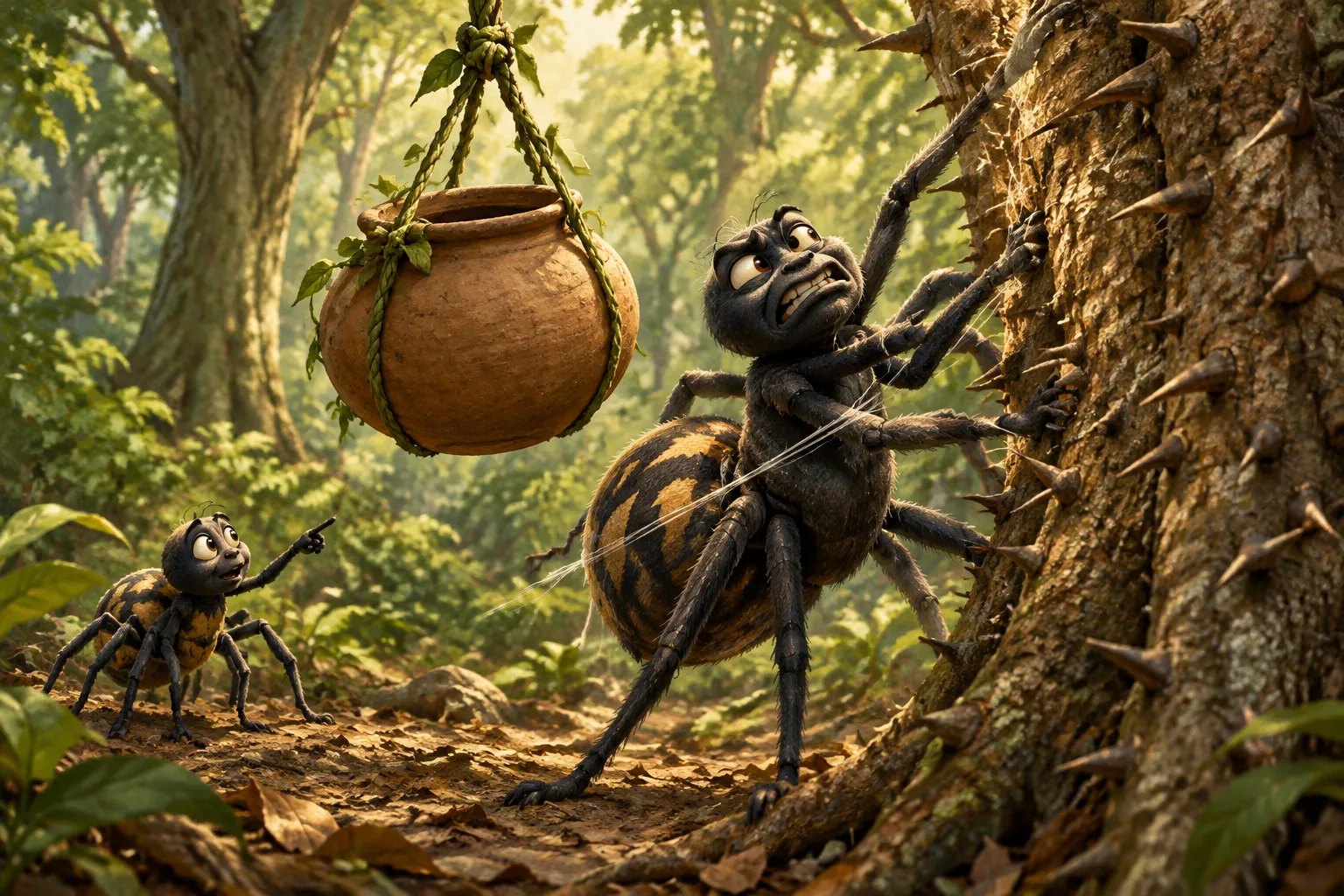
Ananse has gathered the world’s wisdom, but he cannot solve the problem immediately in front of him: how to climb a tree with a pot blocking his way. His son can. That small reversal is the heart of a story discussed within the Akan wisdom tradition of Ghana. The would-be owner of every answer needs advice from someone he has overlooked.
The question is not simply whether Ananse is clever. It is whether wisdom can belong exclusively to anyone—and whether possessing it means knowing how to act. Reading three identifiable tellings separately reveals how much depends on the moment when the pot breaks.
A Ghanaian tale, not a single fixed text
Our witnesses are a telling contributed by Ghana-born writer and folklorist Peter E. Adotey Addo, an educational adaptation published by Anike Foundation, and a 2020 scholarly discussion by Emmanuel K. E. Antwi, Isaac F. Adjei and Joseph K. Asuming of Kwame Nkrumah University of Science and Technology. Their account identifies Ananse within Akan folklore; the two storytelling pages use broader Ghanaian or West African labels.
Those labels should not be silently converted into a precise village provenance or an exclusively Asante attribution. The scholarly study describes the Akan as several related communities, including Asante and Fante, rather than one undifferentiated population. None of these three pages establishes the tale’s first performance or a definitive original wording.
The useful approach is therefore to ask what each witness actually says. A modern adaptation is evidence for that adaptation, not a transcript of every earlier performance. Likewise, a scholar’s brief summary serves a different purpose from a storyteller’s full scene. Keeping those differences visible lets us enjoy the narrative without manufacturing certainty about its history.
The son sees what the collector misses
In Addo’s contributed telling, Ananse collects wisdom for himself, suspends the pot in front of his body with a vine rope, and seeks a hiding place in a tall, thorny silk-cotton tree. His watching son suggests moving the load behind him. Ananse follows the advice and reaches the top.
As a reading of this scene, the physical comedy is especially effective because the obstacle is so ordinary. There is no elaborate riddle for the audience to solve. The solution concerns the position of a burden. Ananse’s enormous claim collapses under a small practical test: the person who supposedly possesses every answer has arranged his own equipment badly.
The tree also makes a striking interpretive contrast possible. Ananse tries to put knowledge beyond other people’s reach, yet the useful observation comes from below. Height does not produce understanding. The child does not need to seize the container or defeat his father in a contest; he merely notices what would help.
In that sense, the son’s advice can be read as generous rather than competitive. It offers cooperation where Ananse has imagined ownership. The father’s project depends on excluding others, while the child’s contribution makes progress possible. This is an interpretation of the encounter, not a claim that every performer explicitly announces that contrast.
Three endings change the emotional weight
The differences become particularly revealing at the breaking point. In Addo’s ending, Ananse acknowledges that his son possesses wisdom outside the pot. He then drops it while descending, scattering its contents. Recognition comes before the loss.
The 2020 scholarly summary names the son Antikumah and describes the pot falling and breaking amid Ananse’s frustration. By contrast, in the Anike Foundation adaptation, Ananse throws it down in anger after benefiting from the better carrying arrangement.
These are not interchangeable emotional endings. Read on its own terms, Addo’s sequence allows room for self-correction: Ananse can recognize the flaw in his claim. The angry throw supports a harsher reading. There, being helped is not enough; the humiliation of needing help overwhelms the advantage he has just gained. Frustration in the scholarly summary leaves the event somewhere different again.
It would flatten the evidence to combine the three into one seamless supposedly authoritative version. The shared narrative problem is clear, but the father’s response varies. A reader should be able to distinguish an acknowledged limitation, a frustrated loss and a deliberate act of destruction. Each directs attention toward a different difficulty in learning from another person.
Is the pot a storehouse or a mistaken idea?
The beginning also changes. Anike Foundation’s educational retelling starts with Nyame’s gift: the heavenly deity gives Ananse a clay pot containing wisdom. Its ending connects the scattered contents with farming, making clothes and working iron. Addo instead begins with Ananse collecting wisdom himself.
These openings invite different questions. Receiving something raises the issue of what a recipient should do with a gift. Collecting it raises the issue of whether accumulation can ever be complete. Neither question needs an invented speech about Ananse’s motives; the contrast follows from the two published premises.
For this article’s reading, the pot is more than a convenient prop. It makes an abstract claim visible. If wisdom could be packed into one container, its owner might imagine that locking it away would make everyone else dependent. The son’s intervention exposes the weakness of that picture before the vessel breaks. An answer has appeared where Ananse’s account says no answer should remain.
The scattering ending also places this tale alongside the site’s broader interest in legends about the beginnings of tools and technology. Here, however, the narrow question is access to knowledge within a particular Ghanaian narrative—not a universal account of African invention.
Wisdom requires a response, not just possession
The KNUST authors’ discussion of Akan wisdom emphasizes practical conduct, listening and learning through experience. It also distinguishes respect for worthy elders from the assumption that age automatically guarantees wisdom. This provides context for the father-and-son reversal without making the tale an attack on elders.
My reading is that the child does not replace one absolute authority with another. His useful suggestion does not prove that children always know best. It proves something narrower and harder for Ananse to accept: this particular answer belongs to someone else, and he needs it now.
That distinction keeps the story from shrinking into a simple instruction to share. Sharing matters, but so does receiving. Ananse must be willing not only to release what he possesses but also to accept what he lacks. The encounter tests his capacity to learn at precisely the moment when he believes learning should be finished.
The most revealing moment, then, may precede the crash. For an instant, the claimed owner of all wisdom stands face to face with an unaccounted-for insight. What follows depends on the telling: recognition, frustration or anger. The pot can break in several ways, but the son’s practical observation has already broken the claim of exclusive ownership.
Sources and further reading
- Antwi, Adjei and Asuming, Understanding Wisdom in the Old Testament through Its Akan (Ghana) Parallels (2020). See the sections on Akan wisdom and the Ananse summary.
- Peter E. Adotey Addo’s contributed telling, Ananse and the pot of wisdom. The page credits his collection of folktales and legends.
- Anike Foundation, Ananse and the Pot of Wisdom. An educational adaptation with a divine-gift opening and an angry breaking of the pot.