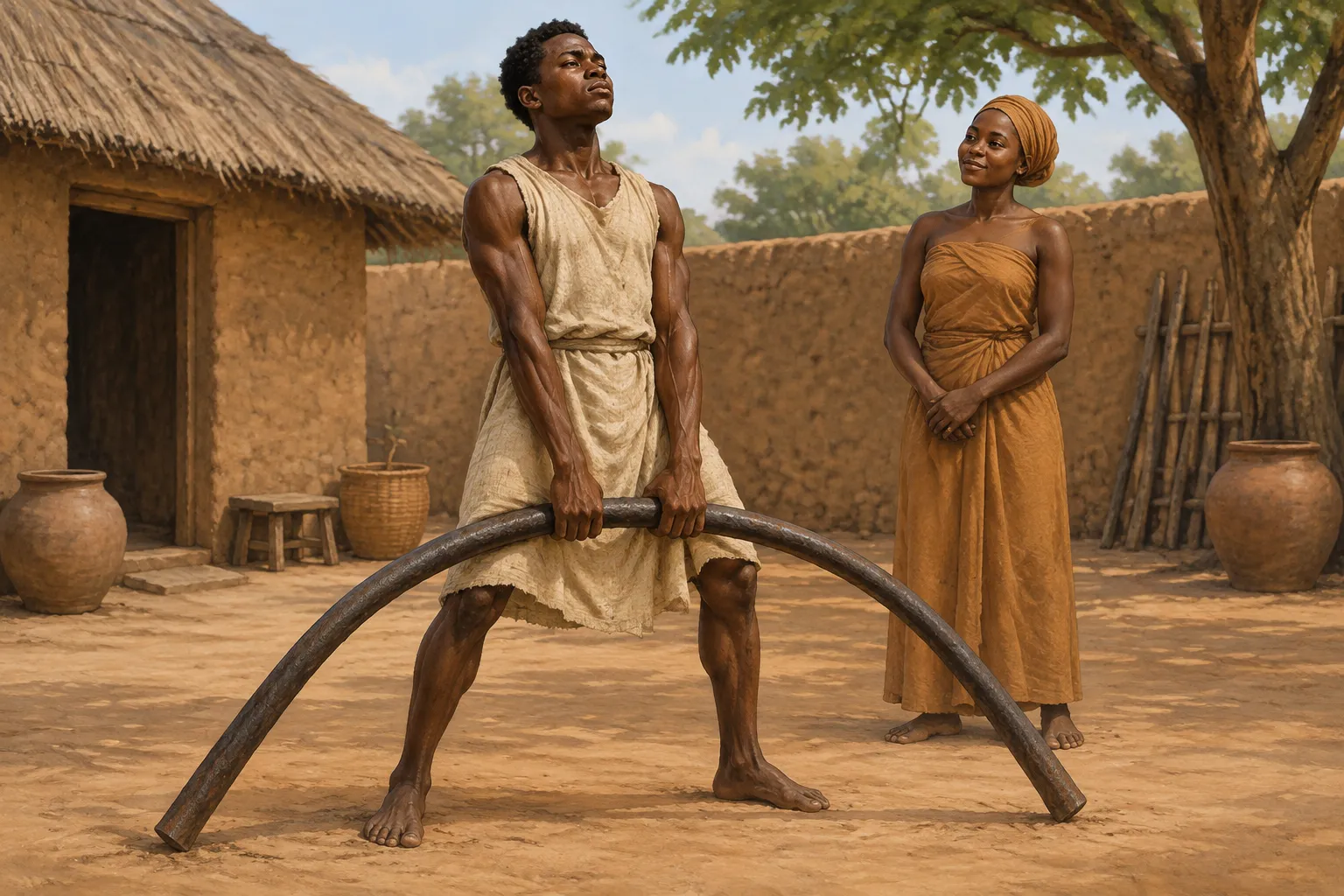
The iron should support him. Instead, it bends. In an episode from the Mande epic of Sunjata, the boy who has not yet walked pulls himself upright against a heavy iron rod. The support becomes a bow-shaped witness to his strength. Boston University’s teaching resource preserves this moment in excerpts from D. T. Niane’s version of the epic.
What makes the scene arresting is not simply the feat. Before the future ruler confronts a rival king, he responds to his mother’s humiliation. Why should the story of an empire’s founder give such weight to an injury within a household?
This article follows that question through the Mandinka and wider Mande narrative tradition associated with Mali and Guinea. Its focus is a particular textual witness and its interpretation, not a claim that every storyteller gives Sunjata the same childhood.
1. A medieval ruler, but no single medieval script
Sunjata, also written Sundiata, is remembered as the founder of the thirteenth-century Mali Empire. The University of California, Berkeley’s introduction identifies the epic’s original medium as oral poetry performed by a professional bard, or jali. It places the story among Mandinka people and across the wider Manding-language region, including Guinea, Mali, Senegal, Gambia and Burkina Faso.
That distinction between ruler and narrative matters. A story set around a medieval founder is not automatically a verbatim record from his lifetime. We can ask what an episode makes meaningful without treating its extraordinary events as independently established biography.
The immediate witness used here is narrower still: selected passages from Niane’s literary version, reproduced in Monique van Gigch’s 2001 curriculum on Boston University’s website. The resource identifies the narrative voice as the griot Mamadou Kouyate and explicitly separates paraphrase from quotation. It is an educational selection, not a complete performance transcript.
The Metropolitan Museum of Art’s account by Hakimah Abdul-Fattah emphasizes that there is no single version of Sunjata’s story. Its summary foregrounds inherited spiritual power in some tellings. We should therefore resist turning the iron rod into a compulsory feature of every telling, or assembling details from several versions into an apparently original whole.
2. An insult becomes the occasion for action
In the Niane excerpts selected by van Gigch, Sassouma mocks Sogolon and her son’s inability to walk. Sunjata then requests the heaviest iron rod his father’s smiths can make. Balla Fasseke, his griot, goes to the master smith; Sunjata raises himself, bending the metal as he stands.
Notice the scale of the initiating event. The narrative does not need an invading army to bring the hero’s strength into view. Someone has made his mother suffer. Read as a scene about responsibility, rather than merely a display of power, the episode asks what strength is for before it asks how much strength the hero possesses.
Berkeley’s interview with classicist Edan Dekel offers a related interpretation centered on family honor: Sunjata’s first great act answers an insult to Sogolon. This is a reading of the epic, not permission to reduce the values of an entire region to one household drama.
The episode can also unsettle the reader’s expectations. If we begin by looking only for a future conqueror, we may overlook the mother whose treatment supplies the immediate moral urgency. The child’s achievement becomes more than an announcement that other people have underestimated him. It answers the question of whom he will defend.
3. What the bent rod lets us see
The rod gives the turning point a material shape. Walking could be described as a change in the boy alone; the bent metal leaves the change visible outside him. As a literary image, it makes the audience measure two things at once: the support he needs and the force that support cannot withstand.
This is an interpretation of the iron-rod scene, not evidence that a surviving object proves the event. The selected passage does not establish the existence of an authenticated relic, and none is needed to appreciate the image.
There is another useful question here: does Sunjata act alone? The feat belongs to him, but the scene gives practical roles to a messenger and a maker. One possible reading is that even exceptional power becomes effective through help. Asking for support need not cancel the hero’s agency; it is part of how the action happens.
Readers should also avoid converting the episode into a lesson that disabled people must perform extraordinary acts to deserve respect. The narrative’s reversal of public expectations is not a rule for measuring anyone’s worth. We can recognize its dramatic force while refusing the assumption behind the mockery: that a person’s mobility determines the dignity owed to them.
4. The griot belongs inside the action
Balla Fasseke’s presence invites us to look beyond the familiar image of a storyteller standing outside events. Berkeley describes the epic’s royal griot, whose name it spells Balla Foureke, as an adviser and keeper of royal memory. The person who preserves the ruler’s story also belongs to the world of relationships through which the ruler acts.
That arrangement offers a productive way to read the childhood scene. Physical strength does not supply its own explanation. Someone must remember the insult, the request and the response if later listeners are to understand why the feat matters. Without that framing, bent iron would be only a marvel.
The Met describes griots as historians, genealogists, poets and musicians as well as storytellers. These overlapping responsibilities help explain why an epic can do more than entertain. A performance can connect an individual adventure to remembered ancestry and communal identity.
For readers interested in another article where a celebrated figure’s apparent self-sufficiency comes under scrutiny, the site’s discussion of Ananse’s pot of wisdom and his son’s advice offers a separate reading. That is an Akan trickster narrative, not a Mande epic variant; the connection is a question about dependence, not an assertion of shared origins.
5. Reading the first steps without flattening the tradition
The Met notes that performers adapt details to their audiences and that listeners may hear their own family names praised within the epic. Variation, in this account, is part of the tradition’s continuing relevance, rather than simply damage to a lost original.
For a reader encountering Sunjata in English, that makes careful attribution especially valuable. Ask which performance, literary version or educational selection is being presented. Ask where a source reports an event and where an interpreter proposes its significance. Those questions do not diminish the story; they make room for its different tellers.
The iron rod offers a memorable entry point because it joins an enormous claim to a personal obligation. We may read it as an image of power becoming answerable to another person’s suffering. The metal bends, but the more consequential change is in how we understand the boy: not merely as someone capable of an astonishing act, but as someone whose act has a reason.
Sources and further reading
- Monique van Gigch, Ancient West Africa: An Introduction, Boston University African Studies Center. Includes selected Niane passages and identifies quotation and paraphrase.
- UC Berkeley ORIAS, Sundiata. Introduction and an interpretive interview with Edan Dekel.
- Hakimah Abdul-Fattah, How Griots Tell Legendary Epics Through Stories and Songs in West Africa, The Metropolitan Museum of Art, April 20, 2020. Context on performance and narrative variation.


