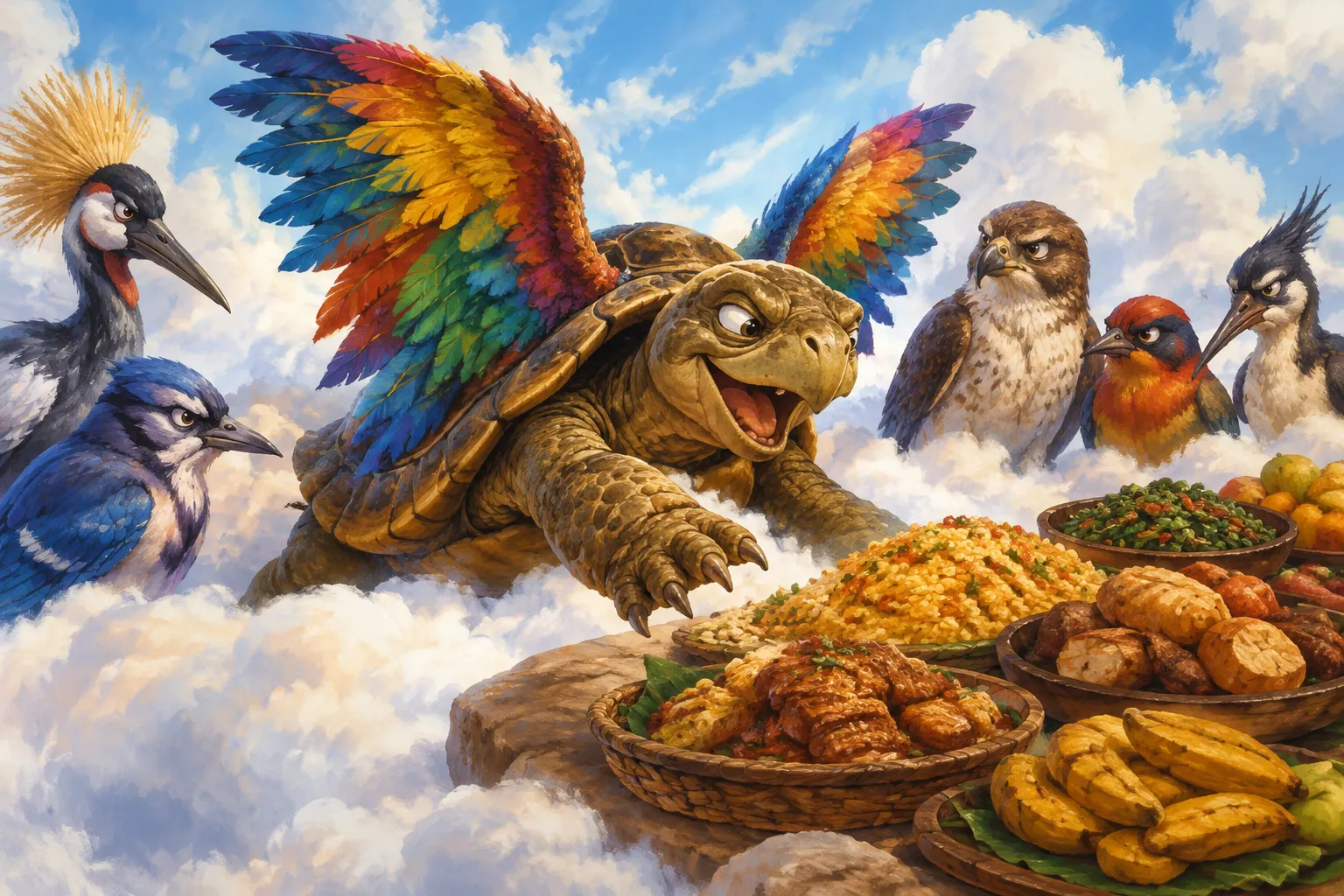
Tortoise reaches the feast because the birds help him. Then he finds a way to make their welcome belong to him alone. His instrument is neither a weapon nor a magical object: it is the name All of You. In a Yoruba-associated retelling published through a University of Ibadan student project in southwestern Nigeria, that small verbal trick turns a shared meal into an act of exclusion—and leaves its author stranded above the earth.
The question is not simply why Tortoise becomes greedy. It is how he persuades others to accept the rule that makes his greed possible. Reading this particular telling closely reveals a story about borrowed abilities, control of language, and the dangerous moment when a group’s representative begins treating everyone’s benefits as his own.
A particular telling, not a single African original
The main text here is Oladejo, Kolawole Orobola’s 2011 account of Tortoise’s rough shell. Its host identifies itself as a University of Ibadan Indigenous Communication student project and presents Ijapa as a hero of Yoruba folktales. That framing places this written retelling within a Yoruba-associated storytelling context; it does not establish a particular village, original performance date, or chain of oral transmission.
Those limits matter. A written student contribution is evidence of the story as presented there, not a transcript of everything Yoruba storytellers have said about Tortoise. Its modern household details also deserve to remain visible rather than being replaced with an imagined ancient setting.
Two other accessible witnesses help establish the boundaries of this reading. Daniel A. Nkemleke’s scholarly entry on a Bafut telling from northwestern Cameroon identifies a different community and narrator. Meanwhile, Rachel Craft’s 2020 classroom retelling labels itself Nigerian without specifying a people. These are related versions of the same narrative pattern, not interchangeable authorities for Yoruba tradition.
Borrowed feathers make the trick possible
In the Ibadan text, birds receive an invitation to a sky feast. Tortoise asks to accompany them. They object both to his lack of birdhood and to his reputation for cunning and greed, but eventually contribute feathers so he can fly. Before departure, he proposes new names and assigns himself All of You. At the meal, he claims the food and wine addressed to everyone. The birds withdraw their feathers, leaving him unable to return. This sequence is explicit in the student-project retelling.
The feathers offer a useful way to interpret the plot. His apparent independence is assembled from other creatures’ contributions. He can enter an otherwise inaccessible place only because several individuals cooperate. The wings therefore make visible something his later behavior denies: his success depends on relationships.
This is not a claim that feathers always symbolize communal obligation in Yoruba storytelling. It is a reading of their function in this particular narrative. Remove the birds’ generosity and there is no journey; remove their continuing consent and there is no journey home. The means of his ascent already contain the possibility of his defeat.
The name that steals a whole table
Why does All of You work so well? In ordinary conversation, the phrase includes every member of an addressed group. As Tortoise’s adopted name, however, he insists that it identifies just one guest. His maneuver turns inclusive language into an exclusive entitlement.
The hosts do not need to be hostile or ungenerous. Indeed, their intention to serve everyone supplies the wording he exploits. Tortoise’s trick depends on separating an expression from its evident social purpose. He treats the meal as though the most literal convenient interpretation must override the reason it was offered.
There is another revealing step: he organizes the naming. He does not merely notice an accidental ambiguity after arriving. In the Ibadan version’s departure scene, he establishes the arrangement that will later benefit him. Read this way, his advantage comes from persuading companions to accept an apparently harmless procedure before its consequences are clear.
Readers interested in another tradition’s challenge to solitary possession can turn to Ananse’s attempt to gather all wisdom in an Akan tale. The traditions and plots remain distinct; the relevant connection is the question of whether one clever figure can rightfully keep a shared benefit.
What changes when another teller takes the story?
The Bafut witness gives the naming a more explicitly representative role. The survey attributes the story to Pa Buweh, a Bafut-speaking farmer and notable, and identifies its published source as Emmanuel Matateyou’s 1997 anthology. In its account of the birds’ election, Tortoise becomes leader and adopts his inclusive name because he is supposed to represent the company. His popularity grows during the flight, making the later betrayal especially pointed.
This difference sharpens an interpretation without proving a historical relationship between the tellings. In the Bafut account, representation itself becomes the trap: a name meant to stand for everyone becomes a pretext for taking everyone’s portion. The Ibadan text needs no election to make its naming device work. Neither version should silently supply missing details to the other.
Craft makes a different adjustment. Her modern educational adaptation has Tortoise announce his name to the sky hosts and explain away Parrot’s objection by distinguishing a first name from a surname. At the end, his wife repairs his shell with tree sap. These are features of that adaptation, not details to insert into the Yoruba-associated witness.
Such differences are part of the reading experience, not defects requiring correction. A story can preserve its central mechanism while changing how the deception begins, who recognizes it, and who repairs the damage.
A broken shell, and a broken agreement
The Ibadan ending turns communication against the trickster. Tortoise asks the last departing bird to tell his wife to prepare a soft landing. Instead, the messenger instructs her to arrange hard, sharp materials. He jumps and is injured; his damaged shell explains its lasting roughness. The published ending names foam cushioning, broken bottles, and nails—details that belong to this telling rather than to a reconstructed timeless past.
The reversal invites a reading more complicated than “greed is bad.” Tortoise first abuses the relationship between words and intended meaning. Later, he must trust someone else to carry his meaning faithfully. The messenger’s betrayal echoes his own, although its physical consequences are much harsher.
Nor must readers treat the birds’ revenge as an ethical instruction. Understanding the narrative’s symmetry is different from endorsing every action within it. Their withdrawal of feathers ends cooperation; the falsified message adds deliberate injury.
The lasting image is therefore not merely a punished appetite. It is a creature discovering that borrowed powers cannot safely be treated as private possessions. His name allowed him to claim everybody’s dinner, but it could not turn everybody’s feathers into his own.
Sources and further reading
- Oladejo, Kolawole Orobola, “How Tortoise’s Shell Became Rough”, May 24, 2011. Main textual witness, published in a Yoruba-framed University of Ibadan student project.
- Daniel A. Nkemleke, “Why Tortoise Has a Cracked Shell”, Our Mythical Childhood Survey. Scholarly presentation of the distinct Bafut witness associated with Pa Buweh and Matateyou’s anthology.
- Rachel Craft, “The Flying Tortoise”, 2020. A modern classroom adaptation labeled Nigerian, used here only for its own narrative choices.